

Llms.txt: What it is and how it can help your business

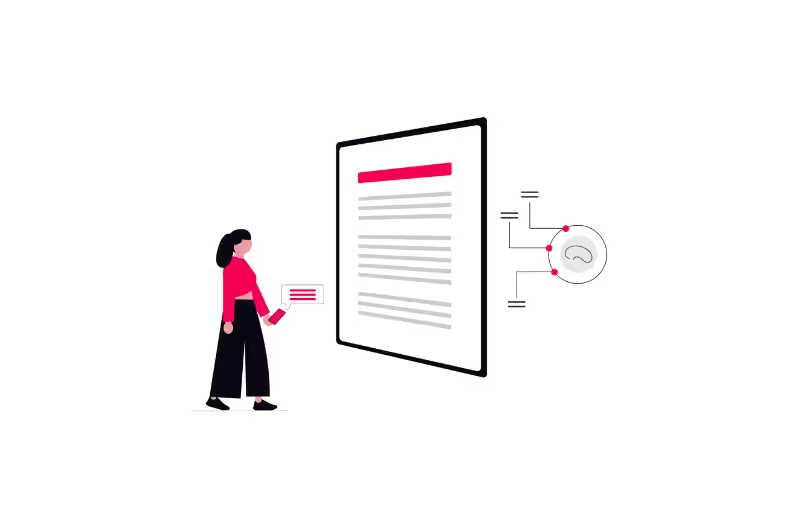
More and more users are accessing information, comparing products, or making decisions through artificial intelligence assistants.
This is where the llms.txt file comes into play: A simple resource that allows you to clearly indicate what content should be considered your company's primary source.
It helps language models identify and prioritize relevant information, thereby improving your presence in AI environments.
In this article, we'll see what llms.txt is, how it's structured, and how you can use it to make your content better represented and more easily discoverable by artificial intelligence assistants.
All about the new llms.txt file
Why start here
Before discussing the benefits, it's important to understand their purpose.
It is common for teams to confuse signals designed for traditional search engines with those used by artificial intelligence assistants.
llms.txt It doesn't compete with SEO: it complements it.
While SEO guides search engines on how to index your website, llms.txt is designed to make it easier for language models to understand when it comes to interpreting and generating answers based on your content.
What it is
llms.txt is a text (or Markdown) file that is placed at the root of your domain. Its purpose is to clearly summarize:
- Who you are.
- What content best represents your company (guides, frequently asked questions, technical documentation, policies, etc.).
- In what order or priority they should be referenced.
It's not about controlling tracking, but about guide language models to the right sources when they generate answers.
What problem does it solve
On websites with a lot of information, complex structures, or duplicate content, language models can lose focus. Between extensive menus, old versions and scripts, they don't always identify which information is valid, current, or a priority.
llms.txt reduces that noise. It explicitly states which content should be considered canonical and What references should be cited, for example, in ChatGPT, thus improving the accuracy of the responses generated and the representation of your company in the environments where AI operates.
.avif)
How it works in practice
Why “How” Matters
You don't need technical knowledge to take advantage of llms.txt. The key is to select the right content, organize it clearly, and provide the right context.
What language models value most is just that: structure and clarity.
General operation
The llms.txt file is located at the root of the domain (https://tusitio.com/llms.txt).
It is readable by both humans and language models, and its objective is to make it easier to understand your most relevant content.
It is structured by thematic blocks, which may include, for example:
- Guides: educational or explanatory content.
- FAQs: answers to common questions.
- Reference: technical documentation, APIs, manuals.
- Policies: legal texts, conditions, notices.
- Languages/Versions: versions by region or language, indicating which one is the main one.
Each block can include a brief description that indicates Who is it intended for that content and In what context should it be used.
This helps LLMs to better understand the intent and target audience of each resource.
What can be measured today
Until recently, AI visibility was a black box: there was no way to know if an assistant was using your content. That has changed. Analytics tools like Microsoft Clarity now allow you to track traffic coming from AI assistants and identify which pages are being cited. For the first time, presence in AI environments can be measured, not just intuited.
And when that data is analyzed, a consistent pattern emerges: AI rarely cites the homepage or "solutions" page; instead, it cites content that answers specific questions with authority — guides, comparisons, technical documentation. The lesson for a B2B business is clear: the leverage isn't a file at the root of the domain, but rather having that content well-structured, technically accessible, and backed by SEO.
What an llms.txt for a B2B manufacturer would look like
Here's the editorial criteria we apply for what to include and exclude in a technical catalog:
- Include: the guides and articles that answer purchasing questions, stable technical documentation, and the canonical product catalog. This is the content that AI actually cites.
- Exclude: ephemeral press releases, campaign landing pages, old versions, and anything that changes quarterly. Flagging unstable content confuses the model and dilutes your authority.
- Prioritize by language/market: always indicate the main version when there are multiple locales, which is key for manufacturers with an international presence.
AI leverages your existing SEO
Assistants and AI Overviews are largely fed by organic results and well-structured, fast, and authoritative pages. In other words: without a solid technical SEO foundation, no llms.txt will save you. We see this in real projects:
- COFME expanded its organic visibility to over 125 countries with a technical and international SEO strategy (hreflang, multilingual, clean architecture). This same foundation makes its content legible for AI.
- BAXI achieved a 110% increase in leads in one year by combining SEO, analytics, and conversion optimization on Sitecore.
- DEACERO relaunched its website with a content structure adapted to its seven vertical markets, coordinating UX/UI and SEO from the design phase.
The pattern: accessible, structured, and authoritative pages. That's what ranks on Google and, today, what makes an assistant cite you. llms.txt, at best, is the icing on the cake — not the cake itself.
Business Benefits
What artificial intelligence says about your company isn't neutral: it can condition purchase decisions, generate doubts in support or affect brand perception.
Having control over the sources that consult language models isn't just a technical issue; it's a strategic decision with direct impact on sales, operational efficiency and reputation.
Key Impacts
- More accurate answers: AI assistants more easily access the right version of your content, which reduces errors, confusion, and generic answers about your offer.
- More accurate citations: By indicating your canonical sources, you increase the likelihood that models will link directly to your pages instead of to third parties or outdated versions.
- Internal Alignment: The file also serves as a common reference for product, support, marketing, or legal teams, helping to quickly identify Which document is the current one.
- Reinforcing trust in your brand: When AI refers to your own resources as a source, it improves your perceived authority and reinforces your position compared to other alternatives.
.avif)
How it relates to sitemap.xml and robots.txt
llms.txt does not replace classic files such as sitemap.xml or robots.txt.
Each one performs a different function in the SEO, and using them together allows for better coverage of the different points of interaction with search engines and language models.
Relationship with sitemap.xml
- sitemap.xml provides a complete view of your site's page inventory. It helps search engines discover and crawl URLs efficiently.
- llms.txt, on the other hand, isn't about breadth, but rather focus: it points out What is the most relevant and reliable content, and in what order they should be consulted.
In short: the sitemap provides coverage; llms.txt provides context and canonicity.
Relationship with robots.txt
- robots.txt states which parts of the site can or cannot be crawled by certain bots. It's an access control file.
- llms.txt doesn't block or limit crawling. Its function is simply guidance: it serves to guide language models to the most useful official resources.
Combining them allows to maintain control over what is indexed, what is tracked, and what is interpreted as the primary source.
Common Mistakes (and How to Avoid Them)
A poorly designed llms.txt loses effectiveness: it disperses attention, leads to incoherent citations, and wastes opportunities to direct AI to your key pages. This is why we recommend that you avoid:
1) Turn it into a “dump” of the entire site
- Why it's a problem: dilutes the signal; the AI doesn't know what to prioritize.
- How to avoid it: Focus only on what is canonical and current. Limit the file to essential blocks (Guides, FAQs, Reference, Policies) and check that each link provides clear value.
2) Align it with the web
- Why it's a problem: If llms.txt prioritizes certain pages while the site's navigation and promotion prioritize others, you generate inconsistent responses and citations.
- How to avoid it: align llms.txt with your information architecture and your CTAs. If you change priorities on the web, Update llms.txt in parallel.
3) Link fragile content
- Why it's a problem: Unstable URLs, pages with pop-ups, or pages dependent on heavy JS break the experience and encourage bad citations.
- How to avoid it: aim for stable URLs and lightweight pages (clear, frictionless content). Version when necessary and avoid routes that change frequently.

CMS for the new form of search
As artificial intelligence assistants gain prominence as search and recommendation channels, it is It is important that your CMS Allow publish a file llms.txt accessible from the root of your domain.
This makes it easier for language models to find your official sources and use them as a reliable reference. Here are some that already have this functionality available.
Webflow
Webflow, allows you to add the llms.txt file from the project configuration, without the need for custom developments.
Just make sure that the file is publicly accessible from yourdomain.com/llms.txt, without redirections or blocks.
WordPress
In WordPress, you can easily manage llms.txt using plugins, without directly touching the server files.
We are convinced that many more CMS will soon be added to support llms.txt.
A small file with strategic value
The true value of llms.txt is not in its format or in its technical implementation, but in How you select, structure, and describe information.
It's about choosing well what to show and helping to understand why it matters.
Not all sites require the same editorial investment, but the trend is clear: artificial intelligence already functions as a channel for search, recommendation, and authority.
Preparing for this environment is not optional in the medium term.
How Novicell Can Help You
Contact with us and our team will help you evaluate the Technical SEO of your website and implement an llms.txt file aligned with your business objectives.
Cómo podemos ayudarte
Consulta los servicios con los que te ayudaremos a conseguir tus objetivos digitales.