

AI Visibility Checklist for Industrial Catalogs
In minutes, validate if your industrial catalog is visible, understandable, and recommendable for AI engines like ChatGPT, Perplexity, Claude, and Google AI.
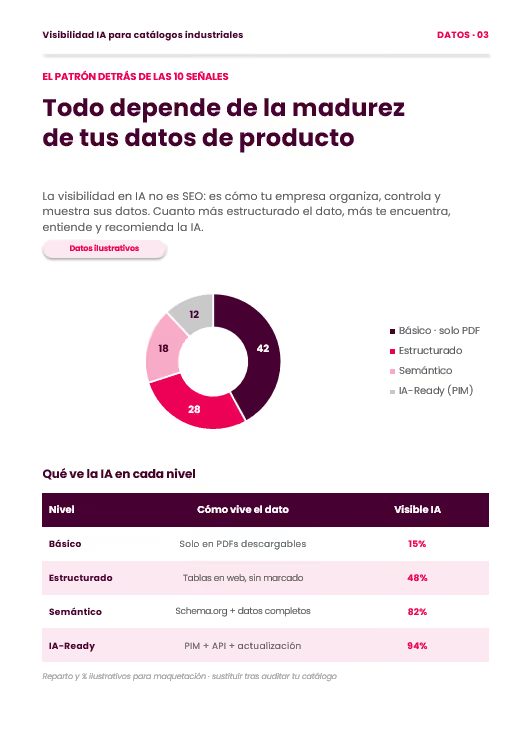
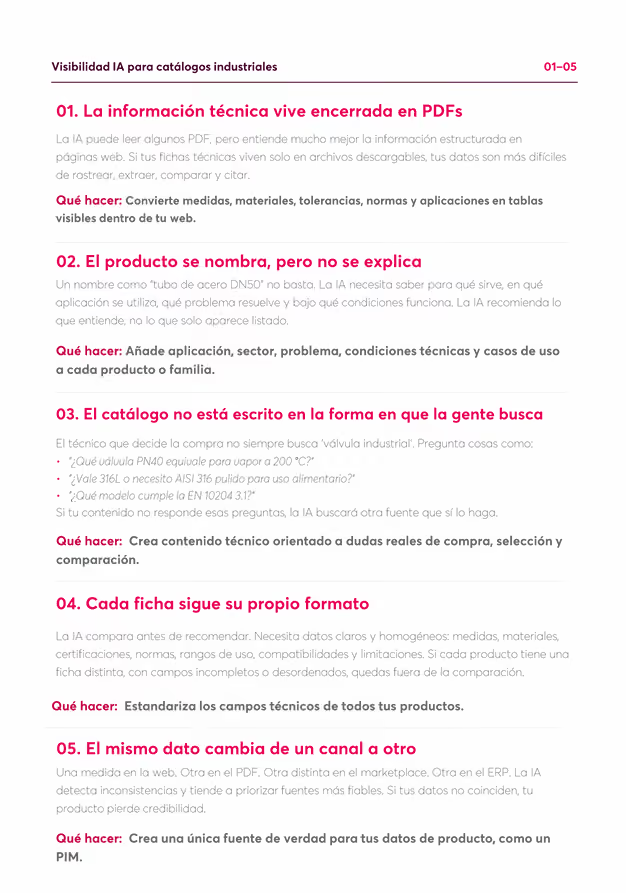
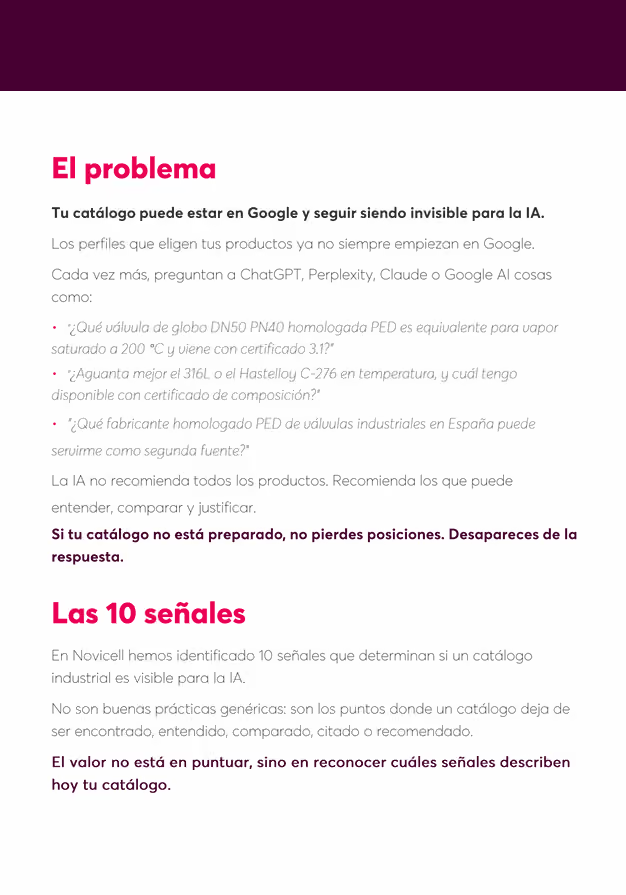
This checklist helps you check whether an AI can find, understand and recommend your catalog.
Why now
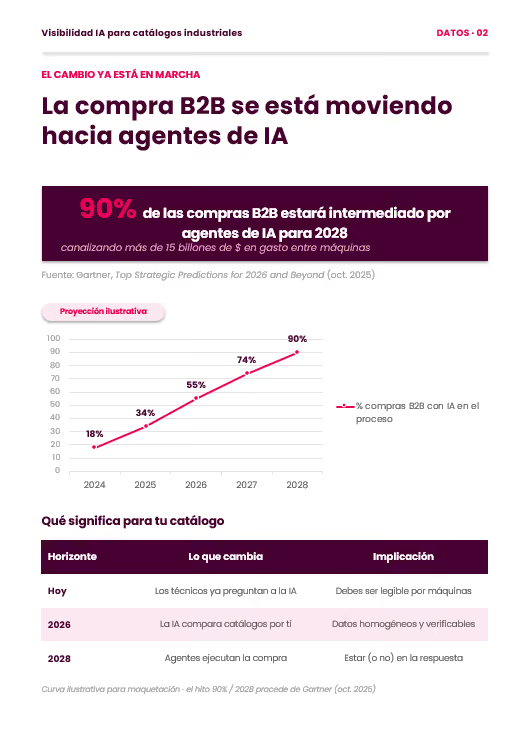
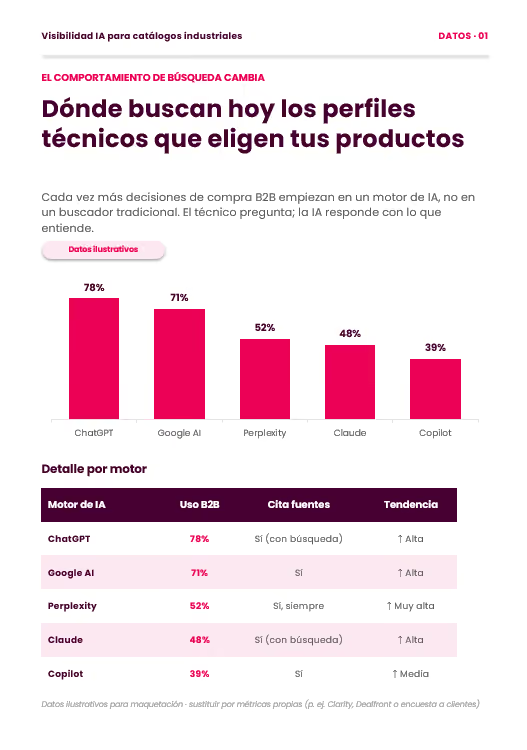
More and more B2B buyers ask an AI before they open a supplier's website. They get one answer with few alternatives. If your product isn't in it, it isn't in the comparison.
You can't see that absence. No report tells you that ChatGPT, Perplexity, Claude or Google have ruled out your catalog. By the time it shows up in your CRM, your competitors are already ahead.
Nobody can promise you a spot in those answers. What you do control is your product data: whether it is complete, consistent and readable by a machine. Cleaning it up takes time, so start before the gap shows.
What content AI cites
An AI doesn't cite what sounds best. It cites what it can read, compare and verify. In an industrial catalog, that comes down to five things.
- Complete, structured product data: every attribute in its own field (material, dimensions, standards, certifications), and nothing buried in a PDF.
- Comparable attributes: same name, same unit and same format across the whole catalog. If one sheet says “DN 50”, another “DN50” and the distributor “2 inches”, the AI can't tell whether they describe the same product.
- Direct answers to buying questions: which model handles 16 bar, what separates two series. A page that answers in its first lines gives the AI something to cite.
- Consistency across sheets, website and channels: the same product says the same thing on your site, in the PDF, on the marketplace and at the distributor. If they contradict each other, the AI doesn't know which to believe.
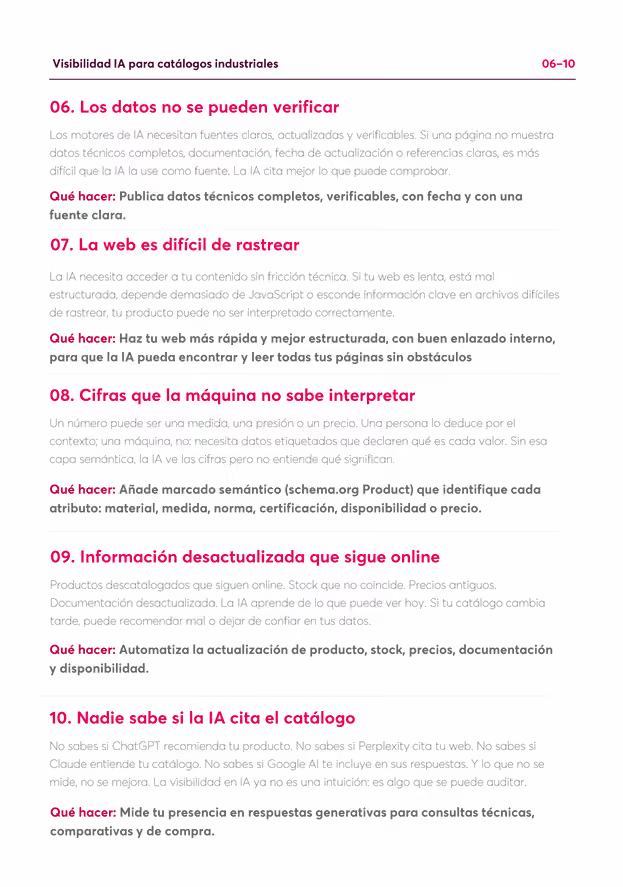
- Schema and llms.txt: schema is markup in the page code that tells a machine what each piece of data is. llms.txt is a file that points models to your key content. It helps, but it is not a standard and guarantees nothing: without tidy product sheets, it does little.
That order usually starts in the PIM (Product Information Management), the system where you centralize product data. This is how we approach it in our PIM for manufacturers and B2B industry.
To go deeper, start with how to optimize your content for AI-generated responses. Then read how to appear in ChatGPT with SEO, and finish with what llms.txt is and how it can help your business.
How to measure your AI visibility
Measuring AI visibility is possible, but incomplete. No tool covers every platform. Start by knowing what each one sees and what it doesn't.
We use Microsoft Clarity. Its AI citations dashboard shows which novicell.es pages Copilot cites when it answers. It has one limit: it only counts citations from Copilot and its partners, not from ChatGPT or Google's AI Overviews. It is a thermometer for one part, not the whole. And a citation is not a visit, so measure traffic and leads too.
Search Console only measures Google, and much of the AI traffic comes through Bing and Edge. GA4 doesn't pick it up well either. That is why we compare all three sources instead of relying on one.
To see how Google brings AI answers into search, read our take on the impact of Google SGE on SEO.
What you get with the checklist
The checklist answers five questions and gives you a clear diagnosis of where you stand. It is a shared starting point for marketing, eCommerce, product and management.
- Why industrial visibility no longer depends only on traditional SEO.
- How B2B buyers discover, compare and choose suppliers in the AI era.
- What an AI needs to interpret and recommend industrial products.
- What barriers can keep your catalog out of the answers from ChatGPT, Perplexity, Claude and Google.
- What steps to take to prepare your catalog and avoid becoming invisible.