

How to structure a multisector manufacturer's website
.avif)
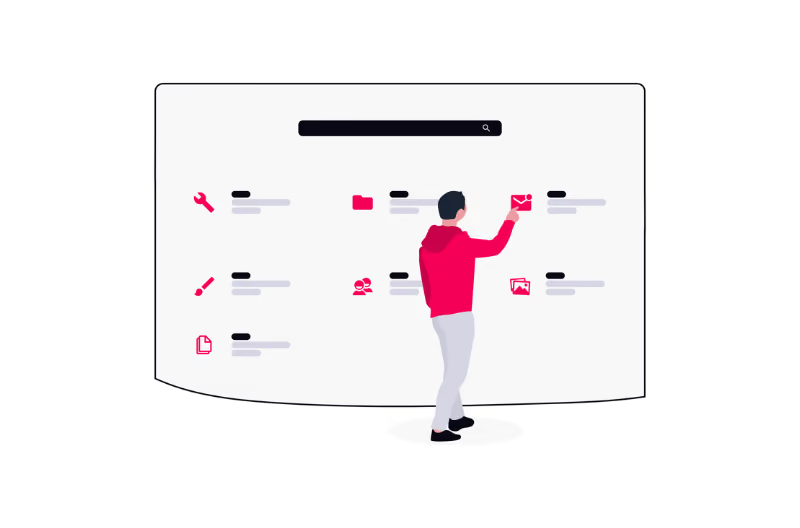
You manufacture a catalog and sell it to four different sectors. The same rod goes to a construction company, the same wire to a farmer, and the same mesh to a hardware store. When it comes time to organize the website, the question arises: do you organize the site by product or by sector?
It is the decision that most influences SEO and lead generation for a manufacturer. And it is almost always made too late, once the design has already been approved. We will tell you the best way to do it.
The same product, buyers who don't search the same way
- A construction manager searches by standard and gauge. They know what they need and type in the technical name.
- A farmer searches by application. They don't type in the factory reference; they type in what they need it for.
- A retail buyer searches by format and volume. They care about packaging and lead times, not the technical data sheet.
Three buyers, three vocabularies, one single catalog.
If you structure the website using internal factory nomenclature, two out of those three won't find you. If you set up a section for each sector and duplicate the product pages, you will cannibalize your own traffic. The task is to resolve that tension before designing.
The three possible structures
By product
The website is organized by families: rod, wire, mesh, profiles.
It works because it matches your catalog and your PIM, the system where centralize your product information. Each reference lives in one place and one place only. Maintenance is inexpensive and there are no duplicates.
Fails at acquisition. Only those who already know the product name can find you. You lose all searches based on application and problem, which are the ones that bring in buyers who haven't decided yet.
By sector
A section for each vertical, with its own language and messaging.
It works for both acquisition and sales. Each sector reads its own content, with its own case studies and arguments. The sales team has a page to send out.
Fails in maintenance and cannibalization. The same product appears in four sections with similar text. When you update one product sheet, you have to update four. Google doesn't know which one to rank and splits authority between competing pages.
Hybrid
A single catalog per product, plus sector-specific landing pages that don't duplicate product sheets.
The rule is simple: the product sheet lives in one place; sector pages explain and link, they don't repeat. The agriculture landing page talks about the application, the problem, and the case study. When the user wants technical details, they go to the catalog.
This is the structure we recommend for almost all manufacturing projects. It takes more effort to define but much less to maintain.

Four questions to help you decide how to structure your site
- Is there search volume by sector? If no one is searching for your product in association with a sector, that section won't bring in organic traffic. Don't discard it for that reason: it serves the sales team and converts. Just don't justify it with SEO.
- Does the purchasing process change? Different decision-makers, different cycles, and different selection criteria call for their own pages. If all four sectors buy the same way, you don't need four paths.
- Do you have a sales team divided by sector? If you do, your website will eventually reflect it. It is better to design for it than to patch it together when each manager asks for their own page.
- How much does your catalog overlap? If 80% of your product is sold to all sectors, a sector-based structure duplicates 80% of your website. In that case, a hybrid approach stops being an option and becomes the only reasonable solution.
The menu is where the decision is visible
The menu is a decision of priority, not an organizational chart. It translates the structure into something that both the user and Google read the same way. Two common mistakes:
- Internal labels. "Construction Division" is what you call it internally. No one outside searches for it that way. Use the buyer's terminology.
- Listing all seven verticals just because they exist. If two of them account for 3% of your business, they shouldn't take up the same space as the one that generates half your revenue.
The menu is a balancing act: what the user finds in three seconds and what hierarchy Google understands.
That is why the SEO team must review it while it is still a wireframe, not after it has been laid out.
How to validate it after launch
You don't get the structure right in a meeting. You adjust it with data.
- Heatmaps. They tell you whether people enter through the sector portal or search for the product directly.
- Internal search engine. What people type into your own search bar is free keyword research. If they search for "livestock fencing" and you call it "knotted mesh," you have your answer.
- A/B testing. They are useful for menu organization and for the landing page of each vertical.
Review those three points every quarter. A manufacturer's structure changes when its business mix changes.
.avif)
An example: DEACERO and its seven markets
DEACERO is one of the leading steel producers in Mexico and Latin America, with a presence in over 20 countries. It sells to the construction, agriculture, industrial, and home sectors. Seven vertical markets based on a common catalog.
When they redesigned their website, we worked on UX/UI and SEO in parallel from the very first wireframe. The content structure and navigation were defined for all seven verticals at once, rather than vertical by vertical.
Two decisions from that project that illustrate the above:
- Keywords were integrated into the navigation menu as part of the SEO work, not as a later touch-up.
- Priority pages were optimized before launch.
After launch, validation continued with Analytics, heatmaps, and A/B testing.
Decide on the structure before designing
A manufacturer's website structure is not a design or SEO decision. It is a business decision made once that shapes the coming years: what your buyer finds, what Google understands, and what it costs to maintain the site every time a new SKU is added.
That is why it must be decided at the beginning, with both teams at the same table and with data in front of them. Redoing it later is expensive and always results in lost traffic along the way.
At Novicell, we have been working with industrial companies for over 20 years, and most face the same decision: how to organize a catalog that sells to different types of buyers.
Contact us and we will review your website structure with our specialists.
Cómo podemos ayudarte
Consulta los servicios con los que te ayudaremos a conseguir tus objetivos digitales.