

What happens when your industrial catalog grows faster than your website


An industrial catalog is never finished. A new reference is added, a product sheet is updated, a specification changes. Something shifts every week.
The problem isn't the catalog. It's the website trying to keep up.
Most product websites are built page by page, by hand. It works for the first year. After that, every new product means starting from scratch, and every change threatens consistency. To touch anything, you have to call development. The website becomes a burden.
That's why we want to show you another way to build it and the process we applied with the microsite for Damstahl in just 4 weeks: one of the leading Nordic distributors of stainless steel and special metals.
Why a product website ages poorly
An industrial catalog has a unique characteristic: it's large, technical, and constantly changing. Dozens or hundreds of references, with specifications, variants, and integration types. And all of that is constantly updated.
A website built page by page isn't prepared for that. Each product sheet was laid out separately, so each one ends up being different. Over time, formats diverge, some are missing fields while others have too many, and the whole loses coherence.
In a sector where precision is the hallmark, an inconsistent website is perceived as carelessness.
.avif)
Component-based architecture changes the rules
The difference isn't in the design. It's in how the underlying structure is built, and this is what determined the project's success.
Reusable components, not loose pages
Instead of laying out each product sheet by hand, we design components: reusable blocks that assemble to create any page. A product sheet, a specifications table, an integration block. They are designed once and used throughout the site.
The advantage is twofold. Creating a new page is no longer a project: it's assembling existing pieces. And when you change a component, the change applies everywhere at once.
Consistency no longer depends on the discipline of the person doing the layout.
A structured CMS for products
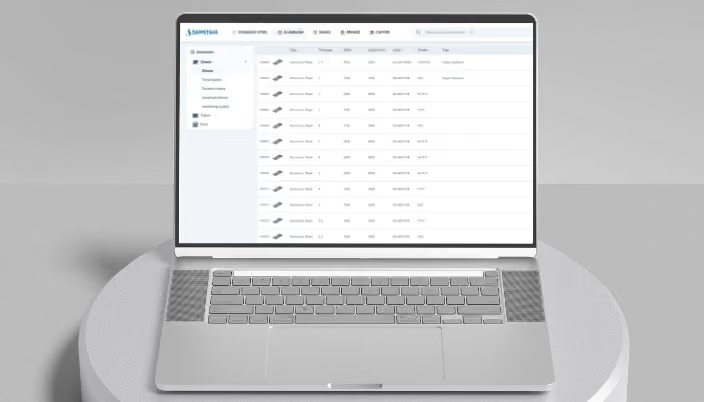
For Damstahl, we configured the Webflow CMS to manage product pages and integration types.
Content isn't free-form; it lives within a structure. When the team adds a product, they fill in defined fields, rather than improvising a page. The result is consistent, no matter who edits it.
Consistency that scales with the catalog
With a component-based website and a structured CMS, the catalog can grow without the website degrading.
The 200th product looks as good and as consistent as the first, and is published in a fraction of the time.
4 weeks for redesign
There was a prior decision that also saved time: not to redo the entire website.
Damstahl didn't need a complete redesign, but rather a solid and scalable product foundation.
Four weeks doesn't mean rushed work. It means having made the right decision before starting: to build a system, not a bunch of pages.
That's why a professional microsite, with on-page SEO from the start and a CMS ready for growth, launched in 4 weeks instead of a multi-month project.
What happens after launch
A product website that the team can't expand is obsolete from day one.
If every new addition requires going back to the agency, the catalog becomes outdated and the website loses its purpose.
That's why we trained the Damstahl team on the Webflow CMS before closing the project. They can add a product, edit a listing, or publish an integration on their own.
Signs that your catalog has outgrown your website
You don't need a major audit to spot it. Look at your website today.
· If two listings of the same type don't look alike.
· If adding a new product takes days instead of minutes.
· If any change results in a development ticket.
The symptom is clear: your catalog grew and your website fell behind. That's not fixed by designing faster. It's fixed by changing the foundations. Moving from hand-coded pages to components that the team assembles and maintains on their own.
The effort is invested once in the system, and the catalog stops being a problem every time it grows.
A product website designed for growth
An industrial catalog will always be changing. That's its nature. The question isn't whether your website can handle today's products, but whether it can handle those of two years from now.
A custom-built website caters to today's catalog. A component-based website caters to the one to come. That's the difference between a website that ages and one that grows with you.
Let's talk about your catalog
If your catalog grows and your website can't keep up, tell us how you manage your products today.
Our specialists will review your content and advise you on the solution that best fits your needs.
Cómo podemos ayudarte
Consulta los servicios con los que te ayudaremos a conseguir tus objetivos digitales.