

Which PIM to choose based on your catalog, channels and integrations


Choosing a PIM shouldn't start with a demo or a quick comparison of features. I should start with a more useful question: What does your company really need to manage its product information well.
There are businesses with few products, but with a lot of variants, languages and channels. Others have a high volume of SKUs, although a relatively simple structure. There are also companies where the main challenge is not in the catalog, but in the integration with ERP, eCommerce, marketplaces or B2B portals.
For this reason, choosing a PIM Just because of the size of the company, it is often not enough. What really makes the difference is the combination of catalog complexity, number of channels, integration needs, required synchronization speed and way of working of the teams.
In this article, we review the criteria that should be evaluated before deciding and what type of solutions usually best fit each scenario, with special attention to Sales Layer, Struct, Akeneo, DynamicWeb, Bluestone PIM and Perfion.
What you should really consider when choosing a PIM
Before comparing solutions, you need to know what really matters in your context. Here are the six main criteria.
1. Volume and complexity of the catalog
Managing 3,000 products with simple sheets is not the same as 50,000 SKUs with variants, technical attributes, documentation, market prices, materials, translations and relationships between references.
The number of SKUs matters, but what really makes the difference is the complexity of the data model. A technical catalog with many dependencies between attributes or with different rules depending on the channel is more demanding than a high volume of simple products.
2. Number of channels you publish on
Publish in a eCommerce own does not require the same thing as operating in multiple marketplaces, distributors, commercial catalogs, B2B and international portals simultaneously.
The more channels, the more important it is that the PIM adapts content according to destination, maintains consistency and avoids repetitive manual work.
3. Required synchronization speed
There are two different models:
- Batch (traditional): The PIM exports information at fixed times. It works for stable catalogs, but it's problematic if you need quick changes. It takes hours for a price change to spread to all channels.
- Real-time: Changes are synchronized instantly. A price change in the PIM reaches your channels in seconds. Critical for flash sales, competitive repricing, and inventory accuracy.
4. Integrations with other systems
In practice, PIM rarely works alone. It usually needs to connect with ERP, DAM, CMS, eCommerce, automations and feeds.
The important thing is to see if the platform really fits your ecosystem, if it has connectors ready to use and if it allows a reasonable deployment without excessive technical dependencies.
5. Teams that will use the tool
In some companies it is used by two marketing people. Others involve eCommerce, IT, sales, purchases, distributors and local teams from various markets.
With more profiles involved, permissions, workflows, traceability and ease of collaboration become important.
6. IT dependency that you want to assume
There are two approaches:
Functional autonomy: Marketing, product or eCommerce can manage much of the work without continuously relying on development. It needs an intuitive, no-code interface.
Technical robustness: More sophisticated solution that requires dedicated IT equipment, but offers more control and architectural flexibility.
If you still have questions about what a PIM specifically works for, we invite you to read This article where we explain it in detail.
PIM solutions and when they fit
Each PIM solution solves a different problem. There is no “best” in the abstract, but the one that fits your reality: the size of your catalog, your time requirement, the systems you need to connect with, and who will use it every day.
What follows is a guide to six options: when to choose each one, how long it takes to implement it, what to expect from the price, and what limitations it has. The goal is for you to see where your case fits.
1. Sales Layer: Fast deployment without complexity
Sales Layer is for companies that need to tidy up the catalog quickly, start working in weeks, operational autonomy without depending on IT.
Typical context: eCommerce startups that migrate from Excel sheets, SMEs that don't want a 6-month project, small teams with time pressure. Sales Layer is the option when you need the PIM to be operational soon, without architectural sophistication.
- Implementation time: 6 weeks (the fastest on the market).
- Synchronization: Real-time, ideal for quick changes.
- Best for: SMBs, fast start-up, small teams.
- Pricing: $1,000-$2,500/month depending on users and volume.
- IT Dependency: Lower. Intuitive interface, functional users can handle a lot of it.
When it makes sense: Your catalog needs order, the team wants autonomy, the project is under time pressure and you prefer speed rather than architectural sophistication.

During our interview with Sales Layer, we recorded a live demo. You can see it here.
2. Struct: Flexibility to adapt data without IT
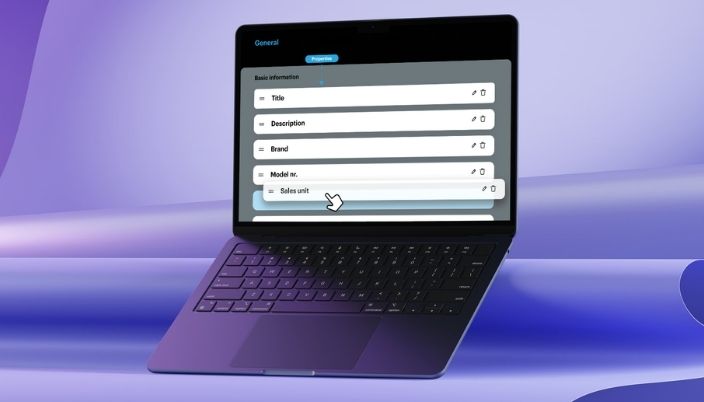
Struct It is for companies that need to continuously change the data model, for functional teams to make changes without code, catalogs that evolve according to the business.
Typical context: Retailers with dynamic catalogs, companies where marketing and product need to be able to adjust the data model on their own without waiting for development. Struct is for businesses that anticipate that their needs will change and don't want to be stuck in a rigid structure.
- Implementation time: 8-12 weeks (depending on data complexity).
- Synchronization: Real-time available.
- Best for: Dynamic catalogs, functional teams, evolving data models.
- Pricing: €2,200-€4,650/month depending on plan.
- IT Dependency: Lower. Visual no-code modeling.
When it makes sense: Your business needs real flexibility in the data model, you prefer business clarity from the start, and your functional teams must be able to adapt the tool without relying on development.
3. Akeneo: The balance between power and usability
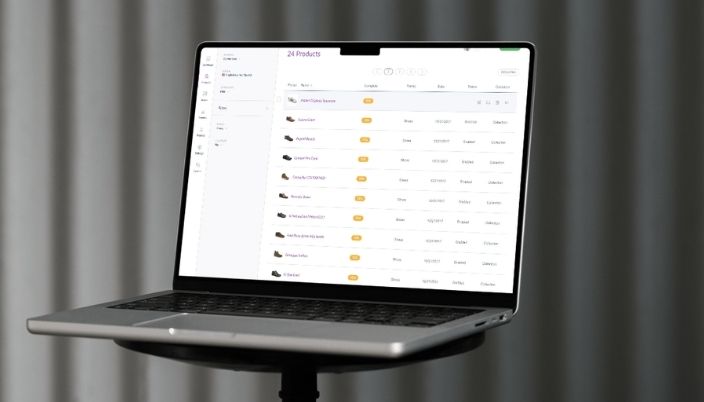
Akeneo is for companies that need a robust but accessible PIM, a balance between capabilities and ease of use, a large partner community and extensive documentation.
Typical context: Medium-sized B2B/B2C companies looking for a middle ground between very agile solutions (Sales Layer, Struct) and very sophisticated solutions (Bluestone, DynamicWeb). Akeneo is the option when you need power but don't want to be tied to a consulting partner all the time.
- Implementation time: 8-16 weeks (varies a lot depending on whether you use Community or Enterprise Edition).
- Synchronization: Real-time and flexible.
- Best for: Medium-sized companies, complex catalogs, multiple channels and languages.
- Pricing: Custom (free Open Source version, SaaS version starting at ~€3,000-5,000/month).
- IT Dependency: Average. It requires technical equipment to exploit its full potential, but well documented.
When it makes sense: You need a scalable, community-backed solution, you want flexibility without being tied to a single partner, and you're willing to invest in technical training.
4. DynamicWeb: B2B integration with Microsoft ecosystem
DynamicWeb is for companies that need to connect PIM, commerce and sales catalog on a platform, deep integration with ERP (especially Microsoft Dynamics 365), complex B2B operations.
Typical context: Manufacturers and distributors already on the Microsoft stack who need the PIM to speak natively with their ERP and commerce tools. DynamicWeb is for companies where the PIM is not an isolated system but rather an enrichment layer that must connect perfectly with Dynamics 365, NAV or Business Central.
- Implementation time: 4-6 months (complex project, B2B integrations require time).
- Synchronization: Batch/scheduled (not native real-time, although frequent syncs can be configured).
- Best for: B2B, Microsoft ecosystem, integrated business operations.
- Pricing: Customized according to modules and scope.
- Integrations: Especially strong with ERP and commerce.
- IT Dependency: Medium-High. Requires dedicated technical equipment.
When it makes sense: Your business is B2B, you already have Microsoft as a technological stack, and the integration between product, sales and commercial operations is as important as the catalog.
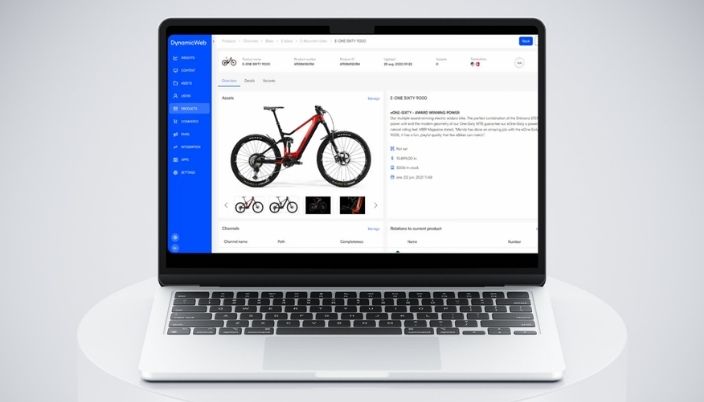
During our interview with DynamicWeb, we recorded a live demo. You can see it here.
5. Bluestone PIM: Composable Architecture for Sophisticated Companies
Bluestone PIM is for companies that need a flexible digital architecture, many integrations with other systems, scalability in multiple markets, modular stack without lock-in.
Typical context: Medium/large companies that think about digital architecture as a whole. Bluestone is for businesses where not only the PIM matters, but how the PIM connects to everything else: eCommerce, CMS, DAM, marketing tools. MicroServices-first, built for companies that want to replace components without rethinking everything.
- Implementation time: 8-12 weeks minimum (complex architecture, not plug-and-play).
- Synchronization: Real-time and flexible as needed.
- Best for: Medium/large companies, sophisticated architecture, multiple markets and integrations.
- Pricing: Personalized, aimed at paying for necessary capacities.
- Architecture: Composable, API-first (500+ endpoints), extensible with packaged business capabilities.
- IT Dependency: Average. It requires technical equipment to unlock its full potential.
When it makes sense: Your company is already thinking about digital architecture as a whole, you have several markets, you need a lot of integrations and you prioritize technological flexibility over simplicity.
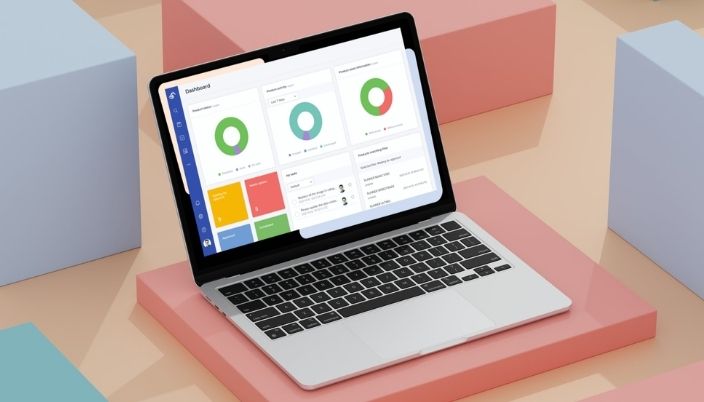
We interviewed Bluestone PIM and recorded a live demo. You can see it here.
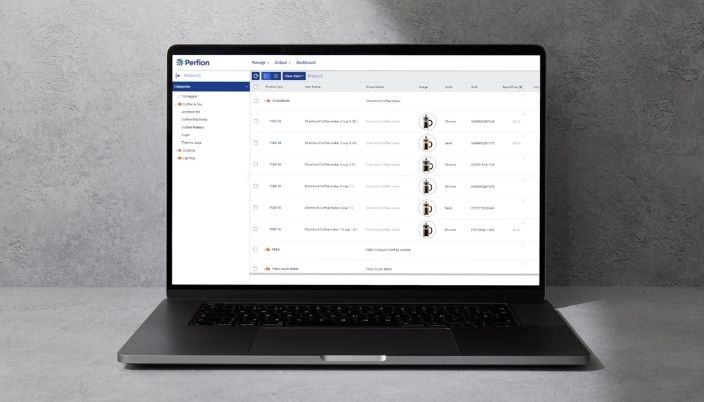
6. Perfion: Data accuracy for technical product
Perfion is for companies that need to manage complex technical information, comply with compliance regulations, maintain accurate data for manufacturers and distributors, deep integration with ERP.
Typical context: Manufacturers and industry where the accuracy of technical specifications is critical. Perfion is for companies where a missynchronized attribute causes returns, claims, or regulatory non-compliance. It stands out for its native integration with Dynamics 365 and data governance capabilities.
- Implementation time: 3-6 months (fast for technical projects, but the complexity of the data is high).
- Synchronization: Batch (not native real-time).
- Best for: Technical catalogs, manufacturers, distributors, industry.
- Pricing: Customized according to requirements.
- Specialization: Technical product, data accuracy, ERP integration (especially Dynamics).
- IT Dependency: Average. It requires technical but well-structured equipment.
When it makes sense: Your catalog is technical and complex, the ERP plays a lot of operational weight, you need precision in the data and prepare information for multiple outputs (B2B, distributors, compliance).
How to diagnose what you really need
Before you choose, answer these three questions:
- How quickly do you need to be up and running?
- In 2 months: Sales Layer or Struct (fast maximum).
- In 4-5 months: Akeneo or Bluestone (medium term).
- In 6+ months: DynamicWeb, Perfion (complex projects, B2B, ERP).
- Who is going to manage the PIM on a daily basis?
- Marketing/eCommerce without IT: Sales Layer, Struct.
- Marketing + IT team for integrations: Akeneo, Bluestone.
- IT as system owner: DynamicWeb, Perfion.
- What is your main challenge?
- “I need to get the catalog out quickly”: Sales Layer.
- “My catalog is constantly evolving”: Struct.
- “I have a lot of products and channels”: Akeneo.
- “I must integrate perfectly with Dynamics/ERP”: DynamicWeb, Perfion.
- “I need flexible and scalable architecture”: Bluestone PIM.
Choosing a PIM goes beyond names
The best way to choosing a PIM it's not starting with the name of the tool, but with the real complexity of your context.
The number of SKUs matters, but so do the channels, languages, variants, integrations, teams involved and the role of IT in the project. Therefore, two companies of the same size may end up needing completely different solutions.
That's where a consultative vision makes the difference: first understanding the real problem, designing the solution, and then choosing the technology that best fits.
We're here to help
At Novicell, we help you to ground your real needs and turn them into clear selection criteria to choose the solution that best fits your company.
It's not about pushing a specific platform, but about making a judicious decision, taking into account catalog, operations, integrations and business objectives. Talk to our specialists.