

Multilingual websites for industrial manufacturers with distributor networks

An engineer in Osaka finds the sensor they need. The spec sheet is in English. The form is, too. They don't know who to buy it from in Japan. They close the tab.
This happens every day to manufacturers who confuse "having a website in multiple languages" with "being ready to sell in multiple markets." They aren't the same thing.
A multilingual website for a manufacturer that sells through distributors doesn't do the same job as one for direct sales.
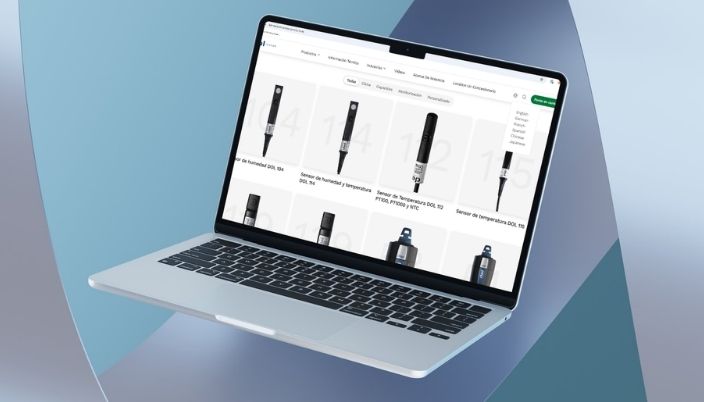
We’ll show you how through a real-world project: the Webflow site we launched for Dol-Sensors, a Danish sensor and monitoring company for the agricultural sector, in 6 languages, with a distributor locator and country-based routing, in 9 weeks.
Scaling globally isn't just translating your website
This is where most international projects fail. Content is translated, versions are published, and the market is considered conquered. Then nothing happens.
Translation is not localization
An automatic translation plugin generates mediocre versions. Google treats them as duplicate or low-quality content. No local sales rep respects them.
Localization is something else: adapting the message, units, examples, and search behavior for each market. It’s the difference between being present in a language and selling in it.
The real challenge is in Asia
Dol-Sensors needed Japanese, Chinese, and Korean.
These aren't just three more languages. They change the typography, the space the text occupies, sometimes the reading direction, and almost always the way people search. A website designed for the Latin alphabet breaks the moment the first Asian character is entered.
It has to be planned from the design stage, not added as a patch at the end.
One platform, not six websites
We manage all 6 languages with Webflow Localization, from a single platform with real control over every version. The team doesn't maintain six parallel sites. They maintain one.
When you grow across markets, that decision is the difference between scaling and multiplying your workload.
When you sell through distributors, your website has a different job
This is the complex part of building a website when you sell to distributors: your site isn't the end of the journey. It's the beginning of someone else's.
The lead's destination isn't you
- In direct sales, the lead goes to your sales team.
- In channel sales, it goes to the distributor in the correct market.
If your website dumps all inquiries into a common inbox, someone has to read them, identify the country, and forward them manually. By then, the lead has gone cold and the distributor complains that the website isn't generating business for them.
The distributor locator is a conversion tool
That's why we built an interactive distributor locator.
The customer finds the nearest distributor without writing a single email. It's not just a "contact" add-on: it's the bridge between interest and an actual sale. And it's what makes your distributor network work with you, rather than around your website.
The "country" field isn't just data, it's routing
Dol-Sensors forms capture name, email, phone number, country, and message.
The country isn't there for statistics. It's there to route each lead to the appropriate market—and distributor—so it goes straight into the CRM without passing through a common inbox.
Capturing the lead is the easy part. Getting it to the person who can close it is what counts.
Why we were able to do it in 9 weeks
A site in 6 languages, with Asian characters and a distributor locator, sounds like a six-month project. But not by working faster, rather by prioritize difficult decisions at the start.
Localization and distributor systems are architecture, not makeup. If you leave them for last, you end up redoing half the project.
That is why we define them before designing the first screen. Webflow allowed us to build, iterate, and publish without the friction of traditional development, and a fixed scope prevented the timeline from being derailed by indecision.
Internal adoption: what many people forget
A multilingual website with a distributor network has two living things to maintain:
- Content in its various languages.
- The list of distributors.
If the team doesn't know how to update them, they end up relying on the agency for every single change.
That is why we provided Dol-Sensors with custom video training for the CMS. The team can edit a profile, adjust a language, or add a new distributor without calling us. Training is what keeps the site alive after launch.
What we bring to the table before we start
Before talking about colors, these are the decisions that make the difference based on our experience.
- Markets: Define which countries have distributors before deciding on languages. Language follows the market, not the other way around.
- Localization: Translation is not localization. Budget for real localization, especially if you are entering Asia. Cutting corners here will cost you in SEO and local credibility.
- Lead destination: Decide where each inquiry goes. If it doesn't automatically enter your CRM and route to the correct distributor, it’s not a system: it’s just an inbox.
- Maintenance: Understand who will be updating languages and the distributor network a year from now.
- Scope: Separate production from indecision. Delays are almost never about production. Finalize the scope and you will save weeks.
Scaling is an architectural decision, not a translation one
If you want to grow in new markets and your website is only translated, you will be late to every single one. What makes you global isn't the number of languages. It’s ensuring that every customer, in any country, can reach the distributor who can serve them in their own language.
That is the difference between a multilingual website and a website built to scale by channel. And almost everything is decided at the beginning, in the architecture, long before execution.
We are here to help
If your plan is to enter multiple markets, the website should be built for that from day one.
We will review your current architecture and tell you what it needs to grow by language and by distributor without having to start over. Talk to our specialists.