

Traffic without leads: what to do to get more B2B prospects
.avif)

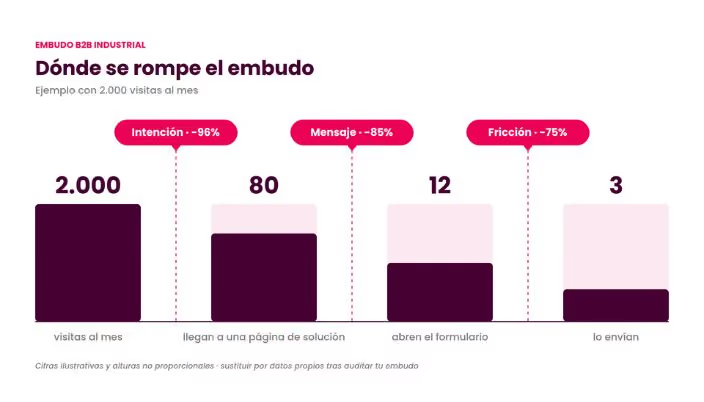
Your website gets 2,000 visits a month and you receive three form submissions. Traffic is up, but opportunities aren't moving.
In industrial B2B, the problem is rarely volume. It’s who is visiting and what they find when they arrive.
In this article, we break down where the funnel breaks and what to do at each stage. This is the workflow we follow for B2B lead generation with industrial manufacturers and distributors.
The funnel doesn't break in just one place. It falls apart at three.
- The first drop-off is the largest and the most overlooked. Traffic arrives that isn't looking to buy: operators looking for a manual, students, competitors. Search engines validate your volume but fail to deliver business results.
- The second drop-off is a messaging issue. A maintenance technician and a purchasing manager land on the same page. One is looking for specifications. The other is looking for total cost and lead times. The page speaks to only one of them, or neither.
- The third drop-off is friction. Nine fields, a country dropdown without a search bar, and a mobile view that forces you to zoom in.
We saw this with Brother, a Japanese manufacturer of printers, scanners, and labeling equipment with over 100 years of history and a presence in more than 100 countries. Their challenge wasn't brand awareness.
It was capturing leads for their industrial products in a saturated B2B market and converting them into real business opportunities.
The three leak points in B2B lead generation
They are listed in order of criticality, and that order matters. Fixing the form while the wrong traffic is coming in only increases conversions from people who aren't going to buy.
A. Traffic without commercial intent
The first filter isn't set by you, it's set by the search engine. And the search engine doesn't distinguish between someone evaluating a 40,000-euro investment and someone looking for the manual for equipment they already have on the factory floor. Both type the same thing. One of them shows up in your monthly report as growth.
- The mistake. You optimize for the keywords with the highest volume. That volume can be generated by someone looking for information, not someone looking to buy.
- Example. A packaging machinery manufacturer ranks for "how a vacuum sealer works." They get thousands of visits a month. These are searched for by plant personnel who already have the machine installed.
- How to diagnose it. Open Google Search Console. Take your top ten keywords by clicks. Ask yourself for each one: is this being typed by someone evaluating a purchase? Cross-reference those pages with conversions in Analytics. The ones that bring in traffic but don't convert have been inflating a useless metric for months.
- What to do. Separate learning keywords from decision keywords. The former fuel your blog and nurturing efforts. The latter go to solution pages and paid campaigns. Classify your top 30 keywords and allocate your paid budget only to the decision-based ones.
How we work with Brother. We start with the audience, not the channel. We define buyer personas and the pain points of each audience together with their marketing, product, and sales teams, based on studies and data, not intuition. With those profiles, we conducted an SEO audit of their entire digital presence and launched paid campaigns targeted at those specific audiences.

B. Landing pages without context
At this point, you've already brought in the right person. You've paid for the click or spent months working on positioningYou have five seconds to make it clear that the page is about their problem. In the industrial sector, that margin is even narrower: the same product is bought for opposite reasons depending on who is evaluating it.
- The mistake. A single message for different types of traffic. The page describes what your product does, not what it solves for the person reading it.
- Example. Someone searching for "industrial printers" wants technical specifications, compatibility, and consumables. Someone searching for "warehouse labeling solutions" wants time savings, ERP integration, and ROI. Same company, two pages.
- How to diagnose it. Three questions for every landing page with traffic:
- Who is this profile written for? If you don't know within five seconds, neither does the visitor.
- Does the first headline repeat the search query that brought that person there?
- Does the proof you show (case study, data, certification) matter to that specific profile?
- What you do. One landing page per buyer persona, not one per product. Take your solution page with the most traffic and duplicate it. Rewrite the headline, the first paragraph, and the proof for the second profile. Send each campaign to its respective page.
How we work with Brother. We optimized the website to rank for searches that were valuable for both the user and the business. The criteria wasn't the volume of each keyword, but rather who is typing it and what they expect to find when they land.
C. High-friction form
This is the most straightforward leak to fix. Even so, it is the most common, because the form is usually designed by the person who needs the data, not the person who has to fill it out.
- The mistake. You are asking for the data your sales rep needs for the third meeting during the very first point of contact.
- Example. An industrial distributor was asking for nine fields to download a catalog, including number of employees and estimated budget. A technician evaluating suppliers doesn't have that kind of time and drops off.
- How to diagnose it. Measure the abandonment rate: how many people start the form and don't submit it. If it's over 60%, the form is the problem. Test it on a real mobile device using mobile data, not on a designer's desktop.
- What to do. Three fields in the first step. Ask for the rest in a second interaction using a progressive form, which recognizes known contacts and only asks for the missing information.
How we worked with Brother. The work didn't end with the form. We set up a CRM with a nurturing plan (email sequences that warm up leads until they are ready to talk to sales) and a dashboard that measures the entire journey, from attraction to closing. That dashboard is the piece that changes the conversation: you stop arguing about traffic and start discussing where the business is being lost.
.avif)
SEO, SEM, CRM, and nurturing work as a system
Separately, each channel improves its own metrics, but none of them improve lead generation.
- The SEO increases impressions.
- The SEM lowers the cost per click.
- The CRM stores contacts. The business remains the same.
With Brother, the starting point was defining the KPIs with their team before touching any channel.
After that, every piece worked toward the same goal: SEO and campaigns to attract the right profile, email marketing to guide them through the funnel, and a CRM and dashboard to see where they were dropping off.
B2B lead generation starts with the keyword and ends with an open opportunity. If you don't measure that entire journey, you're just arguing about traffic.
Concrete action: define two or three business KPIs, not channel-specific ones, and bring them into a single dashboard. Target company visits, qualified leads, and open opportunities.
We're here to help
Traffic, messaging, or forms. One of these three likely mirrors your current situation.
Tell us which one and our specialists will guide you through the next steps.
Cómo podemos ayudarte
Consulta los servicios con los que te ayudaremos a conseguir tus objetivos digitales.