

The Industrial Paradox: Advanced Factories, Outdated Marketing

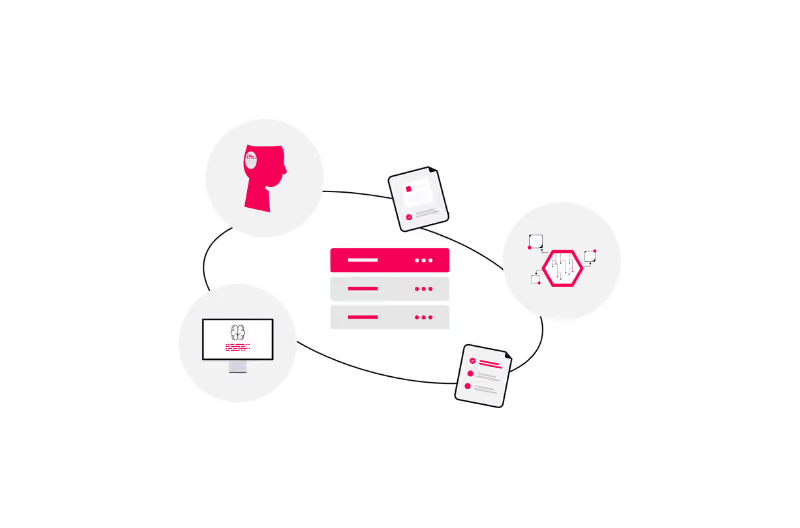
A Spanish industrial plant with thirty years of experience borders on perfection. Lean, Six Sigma, sensors that measure each cycle in milliseconds.
Go upstairs, to marketing and sales, and you enter another century. Five commercials trading from five different Excels. A technical sheet last updated in 2021. An old PDF circulating through distributors with false specifications. A website that takes four seconds to load.
This is the paradox of Spanish industrial sector. And it explains why companies with excellent products are losing their share against competitors with mediocre products but well-organized digital storefronts.
Why the plant invested and marketing was left behind
The most honest explanation is cultural. In the plant, every investment is deterministic.
In marketing, no. The return depends on seasonality, on algorithms that change every six months, on ten or fifteen touch points before a customer signs an order. The committee asks for an ROI figure and the marketer chooses between predicting a number or acknowledging that they don't know it.
For thirty years, investment has gone into production, because the numbers add up there. Marketing and sales have remained like support departments, with tools that were purchased when someone stopped by.
Meanwhile, the B2B buyer has changed. The purchasing manager of an industrial customer no longer calls three suppliers. Open Chat GPT, ask for recommendations, filter by specifications and sign up two or three finalists before anyone on the seller's side knows that it exists.
If your product doesn't show up on that first screen, you've lost. Even if you are the best manufacturer on the market.
.avif)
7 symptoms that reveal that your marketing lives in the past
The diagnosis usually starts with the same signs.
- There is no single version of the truth: Engineering, marketing, sales and distributors work with different documents. When the customer detects the contradiction, he doesn't ask which one is right: he assumes that the company is unprofessional.
- The technical data sheet on the website is a museum piece: Engineering changes the specifications and the old PDF continues to circulate two months later. That's not inefficiency: it's exposure to claims and legal liability.
- Your commercials work like human search engines: The highest-paid account manager spends half a day searching for documents in SharePoint and forwarding forms via email. That time is margin that disappears until it closes.
- The website loads in four seconds and you lose the customer in three: In the plant, cycle time is measured in seconds. In the digital storefront, four seconds of silence are accepted as if it were normal.
- It takes three weeks to quote a technical offer: Every offer requires a back and forth between sales, engineering and purchases that sometimes ends in impossible configurations. On the ground, the Poka-Yoke prevents it; in sales there is no equivalent.
- The website treats a customer of two million as it does a student: The ERP knows the history, the negotiated prices and the stock of each account. The web ignores all that and shows the same thing to anyone.
- Your SEO is optimized for Google in 2015: Repeated keywords, structure from a decade ago, zero structured data. When a buyer asks an AI for a supplier, your company doesn't show up.
The inconvenient truth: you already have a marketing stack, it's just analog
If you look closely at the seven symptoms, there's something they all share. Each one describes a piece of software that already exists in your company. It's just not software.
Tu PIM It is the master Excel maintained by the engineering manager.
Tu DAM is the “Renders_Final_V3" folder on the shared server.
Tu CMS It is the website that an employee of the technical team updates when he has time.
Tu CPQ It is the memory of the senior sales representative who has been with the company for fifteen years.
Tu CRM is the Outlook of every seller.
The problem isn't that you lack technology. The thing is that the one you have doesn't scale, it's not audited and it doesn't survive rotation.
The good news is that you already apply the discipline to fix it every day on the floor. All that's left is to go up one floor.
.avif)
5 pieces that turn your analog stack into one that scales
When it comes to your stack, order does matter.
1. The Excel Product Master → PIM
What do you have today: a spreadsheet where the good version of the specifications lives. It is maintained by the engineering or product manager. When a tolerance changes, it updates it and notifies anyone who remembers to notify by email.
Why doesn't it scale: On the day that person is discharged, no one knows if the PDF that circulates through the distributors reflects the latest version or one from six months ago. When you want to launch in a second language, someone copies and pastes it into another Excel and the offset begins. When the buyer asks an AI about your product, there's nothing structured to read.
What a PIM is for: centralizes all product information in a single system from which the web, catalogs, partner portals and marketplaces drink. When engineering changes a specification, the change reaches all channels at the same time, translated into all languages. And leave the data structured so that an AI can recommend you when a potential customer consults it.
The Ege Carpets case: from the last-minute sprint to the scheduled publication
Ege Carpets, a B2B carpet manufacturer, managed the launch of new collections as a last-minute sprint. Marketing, engineering and sales running in parallel, each with its own version. By connecting the PIM to the ERP, the flow was reversed: each product received its web code weeks before the launch date, and the team used that margin to enrich sheets with images and descriptions. On the day of the launch, the entire collection was activated on the web with all the data up to date. The release ceased to be a race and became a scheduled publication.
2. The “Renders_Final_V3" folder → DAM
What do you have today: a shared server with folders that no one dares to touch. Multiple versions of the same render. CAD files mixed with photos from last year's event. When marketing needs a visual of a turbine, ask in the team chat and wait for someone to respond with the right link.
Why doesn't it scale: The obsolete render is still in circulation months after the product has changed. External agencies receive old versions. Nobody knows what asset can be used in which market or until when the rights to the contracted images expire.
What is a DAM for: save each 3D render, CAD file, technical drawing, video and brand asset in a single versioned site, with rights management, expiration dates and approval flows. When you remove the old render from a turbine, the new one spreads to all contact points instantly. And anyone on the team, inside or outside the company, finds the right file without asking.
3. The website that is updated when there is time → CMS
What do you have today: a website made a few years ago, probably on a traditional CMS, which is edited by asking the technical team or agency for changes. Each modification takes days. Customization by type of customer is a box that has never been activated.
Why doesn't it scale: you can't react to the pace of the market. Launching a landing for a new sector is a weeks-long project. The website treats all customers the same. And performance is scaring away buyers you never get to see in your analytics.
What is a Modern CMS (headless or composable): It assembles the PIM data and the visuals of the DAM into the final experience, on any device, with performance measured in milliseconds. It allows you to create personalized tours by buyer profile, region or type of contract. And let your marketing team publish without depending on the technical team's schedule.
The BAXI case: from online brochure to the epicenter of the commercial ecosystem
BAXI, a manufacturer of heating systems, came from a CMS platform obsolete with load times that frightened visitors before reaching the content. When migrating to Sitecore they were able to separate the navigation by group of users and begin to customize the tour according to the visitor's profile. The result wasn't just a faster website: it was a change of role. The web went from being an online brochure to being the epicenter of the commercial ecosystem, with conversion-oriented content and a measurable flow of leads for the sales team.
A note: when the PIM data is structured and the CMS exposes it with clean schemas, the AI can read your catalog and recommend you. Without that foundation, you're invisible to the buyer's new workflow. Classic SEO is no longer enough; the discovery involves an AI understanding what you're selling.
4. The memory of the senior commercial → CPQ
What do you have today: The salesman with fifteen years of experience knows by heart what configurations are feasible, what discount he can offer to each customer and what deadlines are realistic. When a complex query comes in, assemble the offer by consulting engineering, purchasing and ERP separately. It takes three weeks.
Why doesn't it scale: that knowledge isn't anywhere except in your head. When he retires or changes companies, he goes with him. It takes years for new commercials to reach their level. Meanwhile, slow quotes mean you lose trades to competitors who respond within hours.
What a CPQ is for (Configure, Price, Quote): apply engineering rules at the point of sale. Incompatible configurations become impossible. The pricing logic per customer (contracts, volume discounts, credit limits, taxation) is applied in real time. And the inventory is checked against the ERP before the offer comes out.
Three-week quotes become three minutes. The system refuses to build what physics refuses to assemble. It's the poka-yoke of your sales process.
5. The scattered Outlooks of each seller → CRM
What do you have today: each salesperson manages their portfolio from their email. Important notes are in WhatsApp conversations. What marketing knows about the customer lives in a different tool. Marketing and sales meet every fortnight to try to reconcile two versions of the same reality.
Why doesn't it scale: nobody knows how much it costs to acquire a customer or what marketing actions produce real business opportunities. When a commercial leaves, their portfolio evaporates. And the marketing director is still unable to answer the chief financial officer's question about return on investment.
What a well-integrated CRM is for: It closes the loop between marketing and sales. Every digital interaction is attributed. Every qualified lead enters the sales funnel. Each offer is born connected to the contract and to the customer's history. And finally, the return on investment in marketing can be calculated with the same precision with which the plant manager calculates the savings of a compressor.
The RENOLIT case: when marketing and sales start to speak the same language
This is the leap that takes the longest to come, because it's not just technology: it's agreeing on what a qualified lead is between two teams that have been speaking different languages for years. With RENOLIT, an industrial manufacturer with whom we have been working since 2019, the real change was that marketing began to be measured by qualified leads and not by traffic, and sales began to accept that a digital lead was worth the same as a fair one. From there, the technological ecosystem (web, campaigns, CRM) ceased to be three different things and began to behave as one.

The architecture we recommend: composable
Our recommendation is clear: compose your stack with the best pieces for each task, connected by APIs. This is called composable architecture.
Why not an all-in-one suite? Because when a part becomes obsolete, you have to rebuild everything. Your company is tied to the pace and prices of a single supplier.
With a composable architecture, each piece can be replaced without touching the others. You evolve in parts, at the pace of your business.
The advantage you already have
The Spanish industrial sector has products that compete with the best in the world. What it doesn't have, in many cases, is the ability to show it.
And in a market where the buyer decides before talking to anyone, not being visible is equivalent to not existing.
The job is not to invent anything new. It's digitizing what already works before it depends on a single person, a single file or a single memory.
At Novicell, we have been accompanying manufacturers, distributors and industrial companies on this move for more than twenty years. We started with the diagnosis, not with the sale of software. If you want to understand which parts of your analog stack should be digitized first, and in what order, Let's talk.
Cómo podemos ayudarte
Consulta los servicios con los que te ayudaremos a conseguir tus objetivos digitales.