

How to build a B2B lead generation system
A practical guide for B2B companies that want to generate leads consistently and repeatably, without relying solely on trade shows and events.
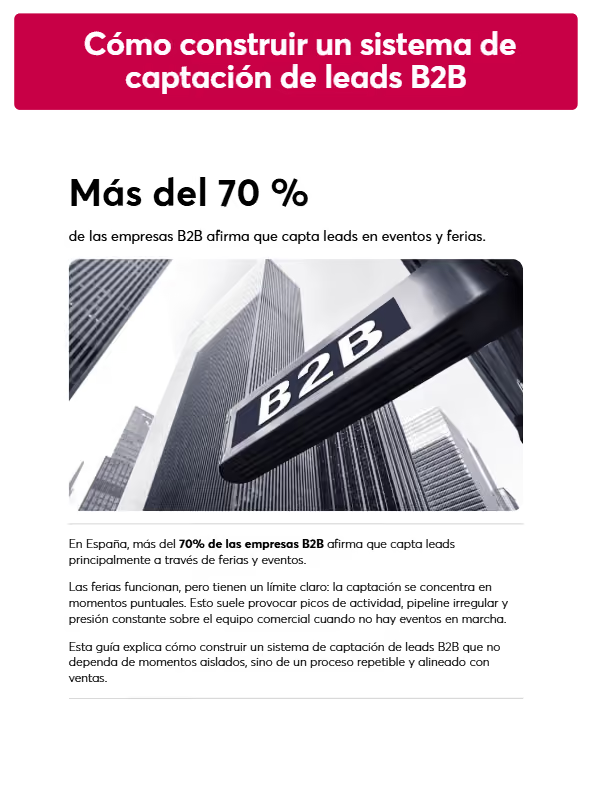
More than 70% of B2B companies generate leads at trade shows and events. What about the rest of the year?
In Spain, more than 70% of B2B companies say they generate leads primarily through trade shows and events. Trade shows work, but they have a clear limitation: lead generation is concentrated at specific moments. This typically causes activity spikes, irregular pipeline, and constant pressure on the sales team when there are no events underway.
This guide explains how to build a B2B lead generation system that doesn't depend on isolated moments, but instead on a repeatable process aligned with sales.
Who is this guide for?
This guide is designed for B2B companies that:
- Need to generate more leads consistently
- Rely too heavily on trade shows, referrals, or historical contacts
- Have a sales team but an irregular pipeline
- Want to open new markets or segments
The 4 pillars of B2B lead generation
1. Defined ICP (who yes / who no)
A clear ICP allows you to prioritize efforts, adjust messages, and avoid leads that don't convert. Without a clear ICP, lead generation becomes generic and inefficient.
2. An offer understandable in seconds
In B2B lead generation, the offer must quickly answer what you do, for whom, and what problem you help solve. If the offer isn't understood quickly, it won't generate conversation.
3. Messages oriented toward opening conversations
The goal of the first contact is not to sell - it's to start a dialogue. Effective messages start from the client's context, address a recognizable problem, and avoid lengthy presentations.
4. Follow-up cadence
In B2B, the first touchpoint rarely converts. Consistency depends on having a defined follow-up process, maintaining contact without being intrusive, and understanding the client's timing. Without follow-up, there is no system.
Case study: from trade shows to a consistent pipeline
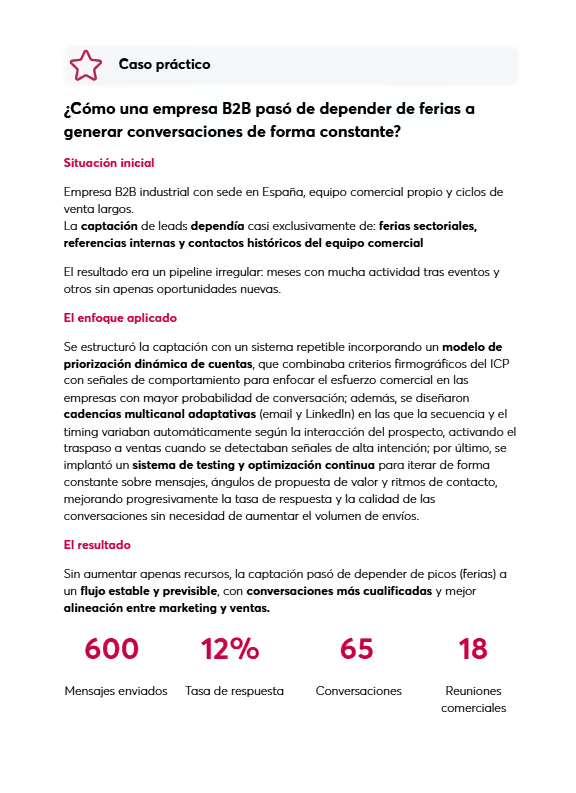
A Spanish B2B industrial company with long sales cycles relied almost exclusively on sector trade shows and historical contacts. They implemented a repeatable system with dynamic account prioritization, adaptive multichannel cadences (email and LinkedIn), and a continuous testing and optimization system.
Results:
- 600 messages sent
- 12% response rate
- 65 conversations initiated
- 18 commercial meetings
Without increasing resources, lead generation went from depending on activity spikes to a stable and predictable flow, with more qualified conversations and better alignment between marketing and sales.
👉 Complete the form and receive the document directly in your email.